Exam 1
Fall 2000
You may use the extra
sheets of paper to solve the following questions, but you please report your
results and conclusions in the space provided.
Whenever possible, show your work for potential partial credit. NOTE:
When performing numerical calculations, keep at least 4 digits after a
decimal. (I.e., do NOT round .2265 to
.23 or .227) BUDGET YOUR TIME WISELY!
1. A survey of undergraduates designed
to gauge political interest is given in the campus center of a small liberal
arts college. The following table
provides a sample of the database.
|
Name |
Age |
Gender (F=1, M=0) |
Political Party |
Years since voted last |
Greek Member (Y=1, N=0) |
Cumulative GPA |
|
Doug |
22 |
0 |
Democrat |
4 |
1 |
2.01 |
|
Margeaux |
20 |
1 |
Independent |
2 |
0 |
3.34 |
|
Brent |
20 |
0 |
Republican |
1 |
1 |
2.98 |
|
Matt |
22 |
0 |
Democrat |
3 |
0 |
2.56 |
|
Pryiam |
19 |
1 |
Reform |
0 |
0 |
3.98 |
a. What are the elements in the data set? (2 points)
b. How many variables are in the data set? (2 points)
c. How many observations are in the data set? (2 points)
d. Which
of the variables are qualitative and which are quantitative variables? Why did you pick these as qualitative or
quantitative? (4 points)
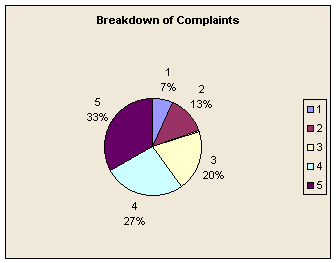
2. The manager of Freedman Furniture Store has complied a list of the types of 75 written customer complaints during the past 3 months. The complaints are categorized as follows:
Use this pie chart and statistical inference to tell the
owners about their pattern of customer complaints. (4 points)
Type Code
|
Use this pie chart and statistical inference to tell the owners about their pattern of customer complaints. (4 points) |
Error in billing =1
Rudeness by store personnel =2
Late Delivery =3
Question not answered during phone inquiry =4
Other =5
3. Corporate Resources Group conducted a study of several cities across the United States to compare cost of living. More than 200 items were used to compile an index measuring the cost of living. These items included housing, food, clothing, cars, drink and entertainment. The cities selected and their ratings are presented below.
|
City |
Cost-of-Living Rating |
|
Atlanta |
72 |
|
Boston |
82 |
|
Chicago |
88 |
|
Cleveland |
70 |
|
Detroit |
81 |
|
Honolulu |
87 |
|
Houston |
85 |
|
Lexington, KY |
71 |
|
Los Angeles |
88 |
|
San Francisco |
86 |
|
St. Louis |
79 |
|
Miami |
89 |
|
Minneapolis |
74 |
|
Pittsburgh |
74 |
|
Portland, OR |
67 |
|
New York |
100 |
|
Seattle |
74 |
|
Washington |
83 |
|
White Plains, NY |
86 |
|
Winston-Salem |
70 |
a. In the space to the right of this table, construct a frequency and relative frequency distribution with 7 classes. (6 points)
b. What specific conclusions can you make with this frequency distribution that may be very difficult to make just using the raw data? (6 points)
4. Describe a scenario where using the median might be more appropriate than using a mean to describe the central tendency of a sample of data. What does the 90th percentile represent as a measure of location? (10 points)
5. The prices ($) of two stocks are shown to vary over a 6-month period.
|
Month |
Stock A |
Stock B |
|
July |
$13 |
$37 |
|
Aug |
16 |
48 |
|
Sept |
11 |
33 |
|
Oct |
10 |
30 |
|
Nov |
9 |
33 |
|
Dec |
13 |
39 |
a. Calculate the mean and median stock prices for both stocks. What does each represent? (6 points)
b. Create a measure of the relative variability of the stocks. Which stock appears to be more stable? (8 points)
6. How and why would you use the Empirical Rule to detect an “outlier”? Begin your explanation by defining an outlier. (10 points)
7.
|
|
|
Son |
|
|
Father |
|
Attended College |
Did Not Attend
College |
|
|
Attended College |
18 |
7 |
|
|
Did Not Attend College |
22 |
33 |
a. What are the marginal probabilities of father and son attending college? (4 points)
b. What is the joint probability of father and son attending college? Of both not attending college? (4 points)
c. Given the father did not attend college, what is the probability that the son did attend college? (4 points)
d. Is attending the college by the son independent of whether his father attended college? Are they mutually exclusive? Explain, using probability values. (8 points)
8. Airline passengers arrive randomly and independently at the passenger-screening facility at a major international airport. The mean arrival rate is 10 passengers per minute.
a. What is the probability of no arrivals in a one-minute period? (3 points)
b. What is the probability of at least one arrival in a 15 second period? (4 points)
9. Suppose historical data shows that a student who majors in Economics will receive 3 job offers for every 8 job interviews. If a student interviews with 10 different companies, what is the probability that he/she will receive exactly 4 job offers? What is the probability that he/she will receive at least one job offer? (5 points)
10. A recent survey of Hanover College upper-class students indicates that the G.P.A. is distributed normally with a mean of 3.1907 and a standard deviation of .3994.
a. What is the probability of a randomly selected upper-class student of being on probation with a GPA below 2.00? (3 points)
b. What is the probability of a randomly selected student having a GPA between 2.50 and 3.50? (5 points)