A Statistical Analysis of Greek vs. Non-Greek Habits and Lifestyles
Introduction
Upon entering college, students must make the decision to join a Greek
organization or remain independent.
There are different lifestyles and habits that develop out of the
decision to join a Greek organization or remain independent. When discussing lifestyles and habits, we are
including drinking, smoking, sleeping, studying, dating, quality of life, GPA,
extra-curricular activity time, and evenings spent out per week. Due to the belief of a large difference
between habits and lifestyles of the two organizations, a survey was
semi-randomly distributed to the campus to try to determine if this difference
truly does exist. Through hypothesis
testing of Greeks and Non-Greeks the statistics show that in some areas there
are differences between habits and lifestyles of the two groups. A regression analysis was also done to
determine the factors which affect the quality of life for
Data
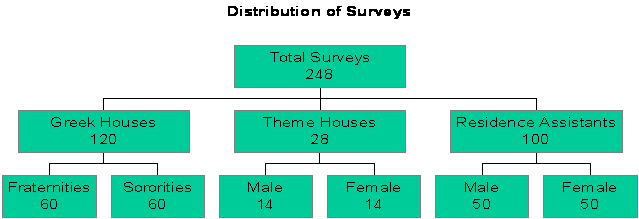
There were 248 surveys
distributed to students through the Greek leaders, Resident Assistants and
theme house leaders. The distribution
within these areas can be seen in the chart below.
Of these 248 surveys distributed,
145 were returned and included in the database.
In order to better understand the statistical analysis of our
information some of the variables must be defined. Students who responded that they were Greek
received a 1 and those responding Non-Greek received a 0. When completing a regression model analysis
Greek will be a dummy variable. In the
gender category, males received a 1 and females received a 0. The GPA was a
cumulative grade point average on a four-point scale. Those students who are currently dating
someone received a 1 and those who are not received a 0. When completing a
regression model analysis, dating someone will be a dummy variable. As for alcoholic beverages consumed, the
quantitative data is number of alcoholic beverages consumed in a week. Another question with data in the weekly form
is the amount of hours outside of class spent studying, including reading
textbooks, completing homework, writing papers, labs, and research group
meetings. Also in a weekly time frame,
we asked how much out of pocket money is spent in dollars. Yet another category
which has quantitative data in a weekly format is the number of evenings
individuals spend out, meaning leaving
Our survey also consisted of other questions so that
the main purpose of our project would not be disclosed, resulting in biased
answers. The questions regarding class
standing, whether the person one’s dating is enrolled at
Summary Statistics
Summary statistics provide
valuable information when analyzing data.
Listed below are all of the summary statistic charts from the relevant
topics on the survey. To avoid
repetition, the following paragraph explains the significance and meaning of
each item that relates to this project in the summary statistics chart. The same concept can then be carried through
when analyzing all of the categories listed below.
Not all of the information given in
the chart is relevant to this project and therefore it will not be
discussed. The measures of location are
mean, median, and mode. The mean gives the average. The median is the number at which 50% of the
values are above and 50% of the values are below. The mode is the number which occurs with the
most frequency. The measures of
dispersion show how widely spread the data is from the mean and includes,
range, variance, and standard deviation.
The range is taken from the difference between the maximum and minimum
values in the data set. The variance
measures deviations from the mean, but is not very useful because it is not yet
in the unit form of the observations.
Finally, the standard deviation is how far, on average, each observation
is from the mean.
|
Non-Greek How Many Drinks a Week |
|
Greek How Many Drinks a Week |
||
|
|
|
|
|
|
|
Mean |
2.443181818 |
|
Mean |
7.737373737 |
|
Standard Error |
0.63091093 |
|
Standard Error |
1.032764208 |
|
Median |
0 |
|
Median |
3 |
|
Mode |
0 |
|
Mode |
0 |
|
Standard Deviation |
4.184989663 |
|
Standard Deviation |
10.27587412 |
|
Sample Variance |
17.51413848 |
|
Sample Variance |
105.593589 |
|
Kurtosis |
6.546079577 |
|
Kurtosis |
2.693720026 |
|
Skewness |
2.3581628 |
|
Skewness |
1.72246934 |
|
Range |
20 |
|
Range |
45 |
|
Minimum |
0 |
|
Minimum |
0 |
|
Maximum |
20 |
|
Maximum |
45 |
|
Sum |
107.5 |
|
Sum |
766 |
|
Count |
44 |
|
Count |
99 |
|
|
|
|
|
|
|
|
|
|
|
|
|
Non-Greek How Much Sleep a Night |
|
Greek How Much Sleep a Night |
||
|
|
|
|
|
|
|
Mean |
7.139534884 |
|
Mean |
6.8775 |
|
Standard Error |
0.196400035 |
|
Standard Error |
0.460134134 |
|
Median |
7 |
|
Median |
6 |
|
Mode |
6 |
|
Mode |
6 |
|
Standard Deviation |
1.287881157 |
|
Standard Deviation |
4.601341345 |
|
Sample Variance |
1.658637874 |
|
Sample Variance |
21.17234217 |
|
Kurtosis |
3.514232053 |
|
Kurtosis |
79.87760792 |
|
Skewness |
1.121895848 |
|
Skewness |
8.539228166 |
|
Range |
7.5 |
|
Range |
46.5 |
|
Minimum |
4.5 |
|
Minimum |
3.5 |
|
Maximum |
12 |
|
Maximum |
50 |
|
Sum |
307 |
|
Sum |
687.75 |
|
Count |
43 |
|
Count |
100 |
|
|
|
|
|
|
|
|
|
|
|
|
|
Non-Greek How Much Study a Week |
|
Greek How Much Study a Week |
||
|
|
|
|
|
|
|
Mean |
15.61363636 |
|
Mean |
16.005 |
|
Standard Error |
1.586050418 |
|
Standard Error |
0.918262935 |
|
Median |
15 |
|
Median |
14.5 |
|
Mode |
15 |
|
Mode |
10 |
|
Standard Deviation |
10.52066827 |
|
Standard Deviation |
9.182629352 |
|
Sample Variance |
110.6844609 |
|
Sample Variance |
84.32068182 |
|
Kurtosis |
1.047581334 |
|
Kurtosis |
1.086171051 |
|
Skewness |
1.118231052 |
|
Skewness |
0.978700722 |
|
Range |
43.5 |
|
Range |
49 |
|
Minimum |
1.5 |
|
Minimum |
1 |
|
Maximum |
45 |
|
Maximum |
50 |
|
Sum |
687 |
|
Sum |
1600.5 |
|
Count |
44 |
|
Count |
100 |
|
|
|
|
|
|
|
|
|
|
|
|
|
Non-Greek Cigarettes a Day |
|
Greek Cigarettes a Day |
||
|
|
|
|
|
|
|
Mean |
0.363636364 |
|
Mean |
1.775 |
|
Standard Error |
0.205862567 |
|
Standard Error |
0.562299347 |
|
Median |
0 |
|
Median |
0 |
|
Mode |
0 |
|
Mode |
0 |
|
Standard Deviation |
1.365537786 |
|
Standard Deviation |
5.622993469 |
|
Sample Variance |
1.864693446 |
|
Sample Variance |
31.61805556 |
|
Kurtosis |
11.65278026 |
|
Kurtosis |
24.26179397 |
|
Skewness |
3.601543258 |
|
Skewness |
4.533139617 |
|
Range |
6 |
|
Range |
40 |
|
Minimum |
0 |
|
Minimum |
0 |
|
Maximum |
6 |
|
Maximum |
40 |
|
Sum |
16 |
|
Sum |
177.5 |
|
Count |
44 |
|
Count |
100 |
|
|
|
|
|
|
|
|
|
|
|
|
|
Non-Greek How Many
Evenings Go Out in a Week |
|
Greek How Many Evenings Go Out in a Week |
||
|
|
|
|
|
|
|
Mean |
1.886363636 |
|
Mean |
2.515151515 |
|
Standard Error |
0.230396086 |
|
Standard Error |
0.135346305 |
|
Median |
2 |
|
Median |
2 |
|
Mode |
2 |
|
Mode |
2 |
|
Standard Deviation |
1.528274739 |
|
Standard Deviation |
1.346678729 |
|
Sample Variance |
2.335623679 |
|
Sample Variance |
1.813543599 |
|
Kurtosis |
2.71322423 |
|
Kurtosis |
1.443924561 |
|
Skewness |
1.474654553 |
|
Skewness |
0.977782214 |
|
Range |
7 |
|
Range |
7 |
|
Minimum |
0 |
|
Minimum |
0 |
|
Maximum |
7 |
|
Maximum |
7 |
|
Sum |
83 |
|
Sum |
249 |
|
Count |
44 |
|
Count |
99 |
|
|
|
|
|
|
|
|
|
|
|
|
|
Non-Greek How Much Time
Spent on Extra-Curricular Activities in a Week |
|
Greek How Much Time
Spent on Extra-Curricular Activities in a Week |
||
|
|
|
|
|
|
|
Mean |
6.647727273 |
|
Mean |
9.816326531 |
|
Standard Error |
0.974920654 |
|
Standard Error |
0.711976671 |
|
Median |
5 |
|
Median |
6.75 |
|
Mode |
0 |
|
Mode |
5 |
|
Standard Deviation |
6.466892019 |
|
Standard Deviation |
7.048209451 |
|
Sample Variance |
41.82069239 |
|
Sample Variance |
49.67725647 |
|
Kurtosis |
-0.54072602 |
|
Kurtosis |
0.535401446 |
|
Skewness |
0.755378872 |
|
Skewness |
1.08661 |
|
Range |
21 |
|
Range |
30 |
|
Minimum |
0 |
|
Minimum |
0 |
|
Maximum |
21 |
|
Maximum |
30 |
|
Sum |
292.5 |
|
Sum |
962 |
|
Count |
44 |
|
Count |
98 |
|
|
|
|
|
|
|
|
|
|
|
|
|
Non-Greek Cumulative GPA |
|
Greek Cumulative GPA |
||
|
|
|
|
|
|
|
Mean |
3.139909091 |
|
Mean |
3.002020202 |
|
Standard Error |
0.085855253 |
|
Standard Error |
0.047782184 |
|
Median |
3.07 |
|
Median |
2.98 |
|
Mode |
3.6 |
|
Mode |
2.8 |
|
Standard Deviation |
0.569499324 |
|
Standard Deviation |
0.475426725 |
|
Sample Variance |
0.32432948 |
|
Sample Variance |
0.226030571 |
|
Kurtosis |
-1.17743921 |
|
Kurtosis |
-0.49084082 |
|
Skewness |
-0.19911422 |
|
Skewness |
0.001958121 |
|
Range |
1.982 |
|
Range |
2 |
|
Minimum |
1.998 |
|
Minimum |
2 |
|
Maximum |
3.98 |
|
Maximum |
4 |
|
Sum |
138.156 |
|
Sum |
297.2 |
|
Count |
44 |
|
Count |
99 |
|
|
|
|
|
|
|
|
|
|
|
|
|
Non-Greek Dating Someone |
|
Greek Dating Someone |
||
|
|
|
|
|
|
|
Mean |
0.613636364 |
|
Mean |
0.46 |
|
Standard Error |
0.074253929 |
|
Standard Error |
0.050090827 |
|
Median |
1 |
|
Median |
0 |
|
Mode |
1 |
|
Mode |
0 |
|
Standard Deviation |
0.492544843 |
|
Standard Deviation |
0.500908266 |
|
Sample Variance |
0.242600423 |
|
Sample Variance |
0.250909091 |
|
Kurtosis |
-1.8527476 |
|
Kurtosis |
-2.014136 |
|
Skewness |
-0.48339809 |
|
Skewness |
0.162969267 |
|
Range |
1 |
|
Range |
1 |
|
Minimum |
0 |
|
Minimum |
0 |
|
Maximum |
1 |
|
Maximum |
1 |
|
Sum |
27 |
|
Sum |
46 |
|
Count |
44 |
|
Count |
100 |
|
|
|
|
|
|
|
|
|
|
|
|
|
Non-Greek Quality of Life at HC |
|
Greek Quality of Life |
||
|
|
|
|
|
|
|
Mean |
6.909090909 |
|
Mean |
7.405 |
|
Standard Error |
0.3029422 |
|
Standard Error |
0.157065096 |
|
Median |
7 |
|
Median |
8 |
|
Mode |
8 |
|
Mode |
8 |
|
Standard Deviation |
2.009491221 |
|
Standard Deviation |
1.570650962 |
|
Sample Variance |
4.038054968 |
|
Sample Variance |
2.466944444 |
|
Kurtosis |
1.478540765 |
|
Kurtosis |
2.720518974 |
|
Skewness |
-1.18480371 |
|
Skewness |
-1.42817189 |
|
Range |
9 |
|
Range |
8 |
|
Minimum |
1 |
|
Minimum |
2 |
|
Maximum |
10 |
|
Maximum |
10 |
|
Sum |
304 |
|
Sum |
740.5 |
|
Count |
44 |
|
Count |
100 |
|
|
|
|
|
|
Although the summary statistics did
not play an integral part in the objectives of the analysis, they were useful
in checking data entry. This was done
through examination of the maximums and minimums in order to detect any extreme
outliers, answers that were not within the scale allowed.
Do Habits/Lifestyles of Greeks and Non-Greeks Differ?
In order to determine if Greek and Non-Greek habits and lifestyles do differ, it is necessary to run a series of hypothesis tests. In order to avoid repetition, the process of arriving at a conclusion will be described. Then, the conclusion of each test will be explained.
Since the project is to determine if the two differ, with it being of no significance to this project which way they differ, a two-tailed hypothesis test was conducted. Each hypothesis test was conducted at a 95% confidence level. The reasoning behind the 95% confidence level was that going higher would include such a large number of the values, as it would have a larger standard deviation, that it would make it very difficult for there to be any difference between any two groups. Since there are no significant consequences if a value falls outside the specified confidence interval, the 95% confidence level provides a high level of confidence without losing all statistical interest. In all cases, the question is if Greeks and Non-Greeks differ on the habit or lifestyle. Therefore the same hypothesis test is used for all categories.
Ho: (μNon-Greek
– μGreek) = 0
Ha: (μNon-Greek
– μGreek) g 0
Since
there are over 30 observations for both Greeks and Non-Greeks, the hypothesis
test was conducted using z-scores. This
process was done through Excel “z-test: Two Sample for Means.” If the critical z-score is closer to the
expected value of the true mean than the absolute value of the test statistic
z-score then the conclusion is to “Reject the Ho.” If the critical z-score is not closer to the
expected value of the true mean than the absolute value of the test statistic
z-score then the conclusion is to “Fail to Reject the Ho
.” The critical z-score for
all of the hypothesis tests conducted in this analysis
at a 95% confidence interval is 1.959961082.
The conclusions follow below.
Smoking
The test statistic for this hypothesis test was -2.356991478. Therefore, since this value is in the
rejection range, the conclusion at a 95% confidence level is to reject the Ho. This means we are 95% confident that there is
a difference in the smoking habits of Non-Greeks and Greeks.
Drinking
The test statistic for this hypothesis test was -4.374542654. Therefore, since this value is in the
rejection range, the conclusion at a 95% confidence level is to reject the Ho. This means we are 95% confident that there is
a difference in the drinking habits of Non-Greeks and Greeks.
Sleeping
The test statistic for this hypothesis test was 0.523759399. Therefore, since this value is not in the
rejection range, the conclusion at a 95% confidence level is to fail to reject
the Ho. This means we are 95% confident that there is
not a difference in the sleeping habits of Non-Greeks and Greeks.
Studying
The test statistic for this hypothesis test was -0.213545661. Therefore, since this value is not in the
rejection range, the conclusion at a 95% confidence level is to fail to reject
the Ho. This means we are 95% confident that there is
not a difference in the studying habits of Non-Greeks and Greeks.
Extra-Curricular Activities
The test statistic for this hypothesis test was -2.624706519. Therefore, since this value is in the
rejection range, the conclusion at a 95% confidence level is to reject the Ho. This means we are 95% confident that there is
a difference in the time spent on extra-curricular activities of Non-Greeks and
Greeks.
Dating
The test statistic for this hypothesis test was 1.715272124. Therefore, since this value is not in the
rejection range, the conclusion at a 95% confidence level is to fail to reject
the Ho. This means we are 95% confident that there is
not a difference in the dating habits of Non-Greeks and Greeks.
Quality
of Life
The test statistic for this hypothesis test was -1.453264279. Therefore, since this value is not in the
rejection range, the conclusion at a 95% confidence level is to fail to reject
the Ho. This means we are 95% confident that there is
not a difference in the views of quality of life Non-Greeks and Greeks.
GPA
The test statistic for this hypothesis test was 1.403362567. Therefore, since this value is not in the
rejection range, the conclusion at a 95% confidence level is to fail to reject
the Ho. This means we are 95% confident that there is
not a difference in the GPA of Non-Greeks and Greeks.
Evenings Out
The test statistic for this hypothesis test was -2.353163182. Therefore, since this value is in the
rejection range, the conclusion at a 95% confidence level is to reject the Ho. This means we are 95% confident that there is
a difference in the number of evenings Non-Greeks and Greeks go out per week.
After this series of hypothesis tests we conclude that there are significant differences in some of the habits and lifestyles of Greeks and Non-Greeks. The statistics show that there is not a significant difference in sleeping habits, studying habits, dating habits, quality of life, or grade point average. However, there is a significant difference in smoking habits, drinking habits, time spent on extra-curricular activities, and evenings out per week for Greeks and Non-Greeks.
Differences in
Greeks and Non-Greeks in those individuals who do smoke or drink
Since a large number of
Ho: (μNon-Greek
– μGreek) = 0
Ha: (μNon-Greek
– μGreek) g 0
The
process was done through Excel using “t-Test: Two-Sample Assuming Unequal
Variances.” If the critical t-score is closer to the expected value of the true
mean than the absolute value of the test statistic t-score then the conclusion
is to “Reject the Ho.” If the
critical t-score is not closer to the expected value of the true mean than the
absolute value of the test statistic t-score then the conclusion is to “Fail to
Reject the Ho.” The
conclusions follow below.
Smokers
The t-score for the hypothesis test was -1.904848897. The critical t-score for this hypothesis test was 2.100923666 at 19 degrees of freedom. Therefore, since this value is not in the rejection range, the conclusion at 95% confidence level is to fail to reject the Ho. This means that we are 95% confident that there is not a difference in smoking habits of Non-Greeks and Greeks among those who do smoke.
Drinkers
The t-score for the hypothesis test was -3.33543. The critical t-score for this hypothesis test was 1.993944 at 88 degrees of freedom. Therefore, since this value is in the rejection range, the conclusion at 95% confidence level is to reject the Ho. This means that we are 95% confident that there is a difference in the drinking habits of Non-Greeks and Greeks among those who do drink alcohol.
Factors that Affect
the Quality of Life of
In order
to determine if there are any significant factors affecting the quality of life
of
Quality of Life = ß0 + ß1 (Current Class
Standing) + ß2 (Cumulative
GPA)
+ ß3 (Dating Someone) + ß4 (How Many Drinks a Week) + ß5 (Greek)
Excel was used to perform the regression analysis; the dependent variable was quality of life and the independent variables were from the categories of current class standing, cumulative GPA, dating someone, how many drinks per week, and Greek. The output from Excel produced the following information.
|
|
Coefficients |
P-Values |
|
Intercept |
5.912153996 |
1.14543 E-08* (99% C.L.) |
|
Current Class Standing |
-.03002359 |
.814550404 |
|
Cumulative GPA |
.531377209 |
.080645344* (90% C.L.) |
|
Dating Someone * |
-.78224982 |
.007119382* (99% C.L.) |
|
How Many Drinks a Week |
-.023795839 |
.16171321 |
|
Greek * |
.526026709 |
.105876953 |
* notes dummy variables * notes statistical significance
In order to determine if there is statistical significance in any of the independent variables, we must conduct a hypothesis test.
Ho:
ß1 =
0
Ha: ß1 g
0
The
same hypothesis test is used for all of the independent variables. Before comparing the p-values it is helpful
to note what results are expected. It is expected that current class standing
will have a negative relationship on quality of life. The rest of the independent variables are
believed to have a positive relationship.
As noted in the above chart, the only independent variables with
statistical significance were cumulative GPA at .080645344 and dating someone
at .007119382. To determine that they were statistically significant the
absolute value of the p-value had to be less than the alpha. The confidence levels where this statistical
significance occurs are noted on the chart. Also, the intercept is statistically
significant, but this is of little importance to our conclusions.
When
examining the data, the following interpretations of estimated coefficients may
be made. If current class standing
increases one year, then quality of life will decrease .0300. If cumulative GPA
increases one point, then the quality of life will increase .5314. If you are dating someone, then the quality
of life will decrease .7822. If you drink one more alcoholic beverage per week,
your quality of life will decrease .0238.
If you are Greek, your quality of life will increase .5260. Notice dating someone is the only independent
variable that is statistically significant at 99% confidence level. Surprisingly to us, there was a negative
relationship between dating someone and the quality of life of a
In order to determine if we have a
good model, the R2 must be analyzed.
The R2 in our model is 0.108596072. This means that our
model explains 10.86% of the variance in the determination of quality of
life. Note that this R2 would not be categorized as an
acceptable percentage of variation explained.
The next regression statistic which we examined was Ra2. In our model this was 0.075334731. It is important to note that this is a few
hundredths away from R2.
This tells us that one of the independent variables does not have a
strong relationship with the quality of life.
One of the statistics which tells us the significance of the model is
the significance of F. In order to
determine if the model is significant, we use a hypothesis test to examine the
significance of F.
Ho: ß1 = ß2 = ß3 = ß4 = ß5 = 0
Ha: ß1 g ß2 g ß3 g ß4 g ß5 g 0
In
our model the significance of F was 0.008170431. Testing at a 99% confidence level, we see that .008170431 is
less than .01. We therefore, reject the Ho and conclude that our model has
statistical significance.
To make sure that
there was not a multicollinearity issue within the model, we developed a
correlation matrix to see if any variables had a correlation of above a .7.
None of our variables had a correlation of above .7. Therefore, multicollinearity is not an issue
within our model.
Conclusion
With Greek life being such a controversial topic in today’s society and media, it is important to see the true difference between students who are Greek or Non-Greek. Students who are coming to the decision of joining or not joining a Greek organization should realize the possible differences between the two lifestyles. In a random survey distributed to 248 students there was a return rate of 58%. Then, we tested to see if there was a difference between the habits and lifestyles of Greeks and Non-Greeks. We also looked at the affect certain habits played into the student’s perceived quality of life.
Our
results show that there is a significant difference in smoking habits, drinking
habits, time spent on extra-curricular activities, and evenings spent out per
week for Greeks and Non-Greeks. It also
shows that dating someone has a statistically significant negative affect on a
student’s quality of life. In addition,
we found that if a student’s GPA increases one point, then the student’s
quality of life will increase .5314 on a 10-point scale.
As
stated, Greek life is a very controversial topic in society and Greek organizations
have recently had large amounts of bad publicity. Our analysis could be used by anti-Greek
organizations as well as pro-Greek organizations to show that there are
differences between Greeks and Non-Greeks. The media could also use this same
information when discussing current Greek issues.
There
are also many uses of the information on college campuses. Faculty members may be interested in the
information so that they could better understand their students by knowing
there are differences in some habits and lifestyles of Greeks and Non-Greeks.
Similarly, administration could use the information when determining whether or
not to promote Greek Life on the campus or in determining whether or not to
allow another Greek organization on campus.
Based
upon the factors that affect the quality of life for college students, a campus
counselor could use the information when dealing with a depressed student that
doesn’t enjoy campus life. For example,
she could advise the student that a poor quality of life could be attributed to
dating someone. Also,
that a better quality of life can be reached by earning a higher GPA.
The
above are only a few ways that the information from our study can be used. However, in reality, any person who comes in
contact with Greek and Non-Greek students could use the information to better
understand the differences in their habits and lifestyles.